
Cell science
for a better future
Scientific evidence · Regenerative medicine
MSC + Wharton's Jelly Exosomes
Cell communication, regeneration and rejuvenation
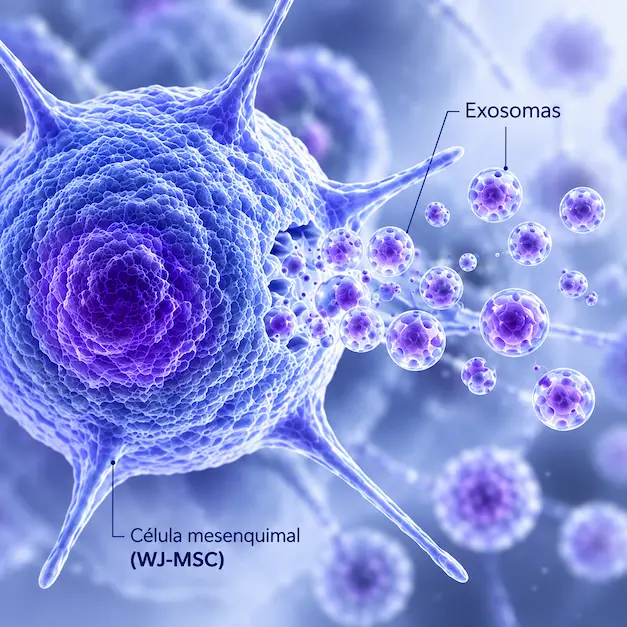
Wharton's jelly mesenchymal stem cells (WJ-MSCs) and their exosomes are investigated for their ability to participate in cell communication and modulate processes related to tissue repair, inflammation and regeneration.
01. Cell communication
MSCs release bioactive signals and exosomes that carry proteins, lipids and microRNAs to other cells.
02. Regenerative microenvironment
These signals are studied for their role in regulating processes associated with inflammation, oxidative stress and tissue repair.
03. Skin rejuvenation
Research with WJ-MSCs and their secretome has shown effects related to fibroblast activity, collagen production and improved cellular skin environment.
More than replacing cells, MSCs can act through signals that modify their cellular environment.
Scientific references
Yin S. et al. (2019).
Human umbilical cord mesenchymal stem cells and exosomes: bioactive ways of tissue injury repair.
Journal of Cellular and Molecular Medicine, 23(5), 3203–3214.
Lee NE. et al. (2026).
Wharton's jelly mesenchymal stem cell-secretome enhances skin rejuvenation via ApoA4 and SERPINH1.
Regenerative Therapy, 31, 101071.
Cicchetti C. et al. (2024).
Topical Wharton's Jelly MSC-Derived Age Zero™ Exosome Treatments After Micro-Needling for Skin Rejuvenation.
Journal of Cosmetic Dermatology, 23(12), 4389–4391.